


Blog
Root KSK Rollover on October 11, 2026: Who Needs to Act (and Who Doesn’t)
October 1, 2026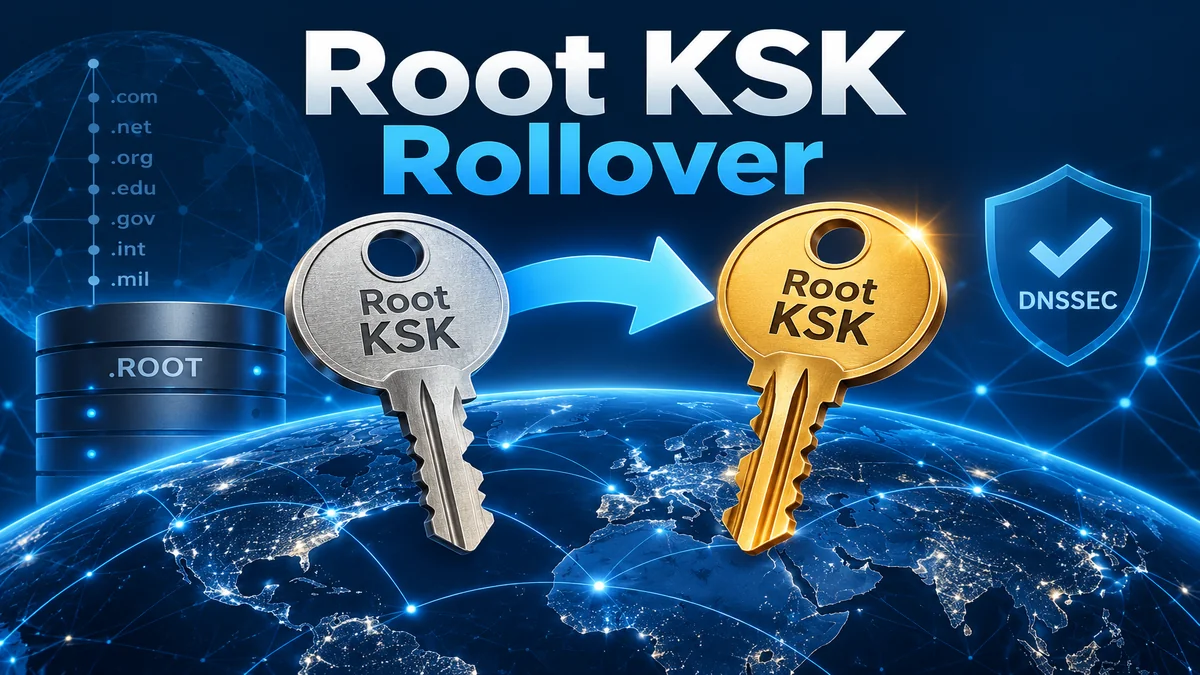
On Sunday, October 11, 2026, the key at the very top of the DNS changes. The root zone will start signing its key set with a new Key Signing Key, KSK-2024 (key tag 38696), and stop using the key it has relied on since 2018. It’s only the second time the root key has ever been replaced.
For most people, nothing will happen. But any DNSSEC-validating resolver that doesn’t trust the new key will stop resolving everything (every website, mail server and API) within about two days. Here’s who needs to check, how to check in a few minutes, and what to do if something breaks. The short version for our customers: if your domains are hosted with CloudFloorDNS, there is nothing to change on your zones.
At a glance
- When: Sunday, October 11, 2026. Any problems show up over the following 48 hours, as resolvers’ cached copies of the old key set expire.
- What changes: The root’s key set will be signed only by KSK-2024 (key tag 38696). KSK-2017 (key tag 20326) stops signing.
- Who must check: Anyone running their own DNSSEC-validating resolver: BIND, Unbound, PowerDNS Recursor, Knot Resolver, Windows Server DNS with trust anchors, dnsmasq or Pi-hole, or a firewall with DNSSEC validation switched on.
- Who doesn’t: Domain owners. Your zones, DNSSEC keys and DS records stay exactly as they are, wherever they’re hosted.
What actually changes on October 11
DNSSEC is a chain of signatures. Your domain’s keys are vouched for by its TLD (.com, .org, .us and so on), the TLD’s keys are vouched for by the root, and the root’s own keys are signed by one key at the top: the root Key Signing Key, or KSK. Every validating resolver carries a copy of that key, called a trust anchor, and checks every signed answer back to it.
Replace the key at the top and every validating resolver on the internet needs the new one. That’s why ICANN published KSK-2024 in the root zone on January 11, 2025, nearly two years ahead of time. Resolvers that update their trust anchors automatically (the RFC 5011 process) have been able to learn it since February 2025.
| Outgoing key | Incoming key | |
|---|---|---|
| Name | KSK-2017 | KSK-2024 |
| Key tag | 20326 | 38696 |
| Algorithm | RSA/SHA-256 (8) | RSA/SHA-256 (8) |
| In the root zone since | July 11, 2017 | January 11, 2025 |
| Signs the root key set | October 11, 2018 to October 11, 2026 | From October 11, 2026 |
| What happens next | Revoked, then removed, in early 2027 | Becomes the only root KSK |
If you ever need to add the new key by hand, this is its DS record. Check it against IANA’s published trust anchors before relying on it. Trust anchors shouldn’t come from a blog post, including this one.
. IN DS 38696 8 2 683D2D0ACB8C9B712A1948B27F741219298D0A450D612C483AF444A4C0FB2B16The timeline
| Date | What happens |
|---|---|
| July 15, 2010 | The root zone is signed with DNSSEC for the first time, under KSK-2010. |
| October 11, 2018 | The first root KSK rollover, from KSK-2010 to KSK-2017. It was planned for 2017 and postponed a year because too many resolvers weren’t ready. |
| January 11, 2025 | KSK-2024 is published in the root zone alongside KSK-2017. |
| February 2025 | Resolvers that update automatically finish their 30-day waiting period and start trusting KSK-2024. |
| Sunday, October 11, 2026 | KSK-2024 becomes the only key signing the root key set. |
| October 11 to 13, 2026 | Cached copies of the old key set expire (their TTL is 48 hours). Resolvers without KSK-2024 start failing. |
| Early 2027 | KSK-2017 is revoked, then removed from the root zone. |
| 2027 to 2030 | ICANN has proposed moving the root KSK from RSA to ECDSA P-256 in a separate, multi-year algorithm rollover. |
Who needs to do something
Only software that validates DNSSEC answers uses the root key. In practice that mostly means recursive resolvers: the servers that look up names on behalf of your computers and phones. Authoritative DNS, where your zones live, never touches the root trust anchor.
| If you… | Affected? | What to do |
|---|---|---|
| Host your domains with CloudFloorDNS (or any DNS provider) | No | Nothing. Your zones are served exactly the same way before and after. |
| Have DNSSEC-signed zones | No | Nothing. Your keys and the DS records at your registrar don’t change. |
| Use your ISP’s resolvers or a public one (Google 8.8.8.8, Cloudflare 1.1.1.1, Quad9 9.9.9.9) | Very unlikely | Nothing. Large operators have had nearly two years to prepare. |
| Run your own validating resolver (BIND, Unbound, PowerDNS Recursor, Knot Resolver, Windows Server DNS) | Check now | Confirm that key tag 38696 is trusted. Steps below. |
| Have DNSSEC validation switched on in a firewall, router or appliance (pfSense, OPNsense, Pi-hole and others) | Check now | Update the firmware or package. Some ship a fixed key list and never update it on their own. |
| Run a resolver in a container, a golden image or a VM restored from an old snapshot | Highest risk | Rebuild from current software and give it persistent, writable key storage. |
The case that catches people out: resolvers that never stay up for 30 days
Automatic updates (RFC 5011) only work if a resolver runs long enough to watch the new key for 30 days and can save what it learned to disk. A container that starts fresh on every deploy, or a VM rebuilt from an old image, only knows the keys built into its software version. If that version predates KSK-2024, it will work fine on Saturday and fail by Tuesday.
How to check a resolver in about five minutes
Run two quick tests
First, ask the resolver for dnssec-failed.org, a domain that’s broken on purpose. Replace 192.0.2.53 with your resolver’s address:
dig @192.0.2.53 dnssec-failed.org AIf the reply says status: SERVFAIL, something in the path validates DNSSEC (this resolver or one it forwards to), so keep going. If you get an IP address back, nothing validates and the rollover won’t affect it. On Windows, Resolve-DnsName dnssec-failed.org -Server 192.0.2.53 should return a server failure.
Second, ask whether it trusts the new key. BIND, Unbound and Knot Resolver answer RFC 8509 “sentinel” queries by default, and Cloudflare’s 1.1.1.1 added them on September 24:
dig @192.0.2.53 root-key-sentinel-is-ta-38696.dnstest.dev A
dig @192.0.2.53 root-key-sentinel-not-ta-38696.dnstest.dev A
An answer to the first and SERVFAIL on the second means it trusts KSK-2024. The reverse means it doesn’t, and it will fail after October 11. Answers to both mean the resolver doesn’t support sentinels (or doesn’t validate), so use step 2.
Confirm key tag 38696 in the configuration
The tests show what the resolver does today. Its trust anchor store tells you whether that survives a restart. Look for 38696 marked as trusted or valid:
BIND 9
rndc managed-keys status
# look for "keyid: 38696" followed by "trusted since"
Unbound (also the resolver inside pfSense and OPNsense)
grep 38696 /var/lib/unbound/root.key
# look for "id = 38696" and ";;state=2 [  VALID  ]"
# the path varies by OS: it's auto-trust-anchor-file in unbound.conf
PowerDNS Recursor
rec_control get-tas
# look for a line containing 38696
Recursor doesn’t roll keys on its own. Version 5.2.0 and later have KSK-2024 built in, but root trust anchors set in your own configuration override the built-in ones, so check both.
Windows Server DNS (PowerShell)
Get-DnsServerTrustAnchor -Name .
# look for key tag 38696 with state Valid
# no root trust anchors at all means this server isn't validating
dnsmasq, Pi-hole and many small routers
grep -r "trust-anchor" /etc/dnsmasq.conf /etc/dnsmasq.d /etc/pihole 2>/dev/null
# you need a line containing 38696
dnsmasq never updates its keys by itself. If 38696 is missing, add it (see “If something breaks” below).
Knot Resolver updates the root key automatically as long as its root.keys file is writable. Run trust_anchors.summary() on its control socket to see what it currently trusts.
Make sure it can keep learning
- Use automatic trust anchors, not static ones:
dnssec-validation auto;in BIND, andauto-trust-anchor-filerather thantrust-anchor-filein Unbound. - Make sure the resolver can write to its key storage (BIND’s managed-keys directory, Unbound’s root.key). ICANN calls this out specifically.
- In containers, keep that storage on a persistent volume and build from a current image.
- While you’re in there, make sure TCP on port 53 isn’t blocked. DNSSEC answers are often too big for a single UDP packet.
Watch it from October 11 to 13
Trouble won’t start at a set minute. It shows up as each resolver’s cached copy of the root keys (48-hour TTL) expires, which could easily be Monday morning. If users say “nothing loads,” compare a normal query with one that skips validation using +cd:
dig @192.0.2.53 example.com A        # SERVFAIL?
dig @192.0.2.53 example.com A +cd    # works with checking disabled?
If normal queries fail for every domain but +cd works, it’s a trust anchor problem. If your resolver supports Extended DNS Errors, dig also prints an EDE line that names the DNSSEC error.
If something breaks
ICANN’s advice is the same for every resolver: restore service first, then fix the key. Temporarily turn off DNSSEC validation, or add a negative trust anchor for the root (RFC 7646), and lookups work again right away. Then install KSK-2024 and turn validation back on. Don’t leave it off.
Unbound: fetch the current root anchor from IANA, then restart
sudo -u unbound unbound-anchor -a /var/lib/unbound/root.key
sudo systemctl restart unbound
Windows Server DNS: pull the current root trust anchors from IANA
Add-DnsServerTrustAnchor -RootPowerDNS Recursor: add it at runtime, then make it permanent in your configuration or upgrade to 5.2.0 or later
rec_control add-ta . 38696 8 2 683D2D0ACB8C9B712A1948B27F741219298D0A450D612C483AF444A4C0FB2B16dnsmasq and Pi-hole: add this line to the dnsmasq configuration, then restart
trust-anchor=.,38696,8,2,683D2D0ACB8C9B712A1948B27F741219298D0A450D612C483AF444A4C0FB2B16BIND: upgrade to a current release, whose built-in bind.keys includes KSK-2024, and use dnssec-validation auto;.
A reminder from May: what a DNSSEC failure looks like
On May 5, 2026, Germany’s .de registry hit a bug during a routine key rollover. DENIC’s signing software generated a separate key pair for each of its three hardware security modules instead of one shared pair, all with the same key tag, so only about a third of the zone’s signatures could be verified. For roughly three hours, people behind validating resolvers increasingly couldn’t reach .de sites, from amazon.de to bahn.de.
Three details from DENIC’s final report and Cloudflare’s write-up are worth knowing before October 11:
- It wasn’t only signed domains. The broken signatures included the records that prove a .de domain isn’t signed, so unsigned .de domains failed too.
- It got worse gradually. Cached answers kept things working at first, and failures climbed as TTLs expired. A missed root key will play out the same way over its 48-hour window.
- The alarms fired, but nobody acted on them. DENIC’s validation tools spotted the errors, but the notifications weren’t processed in time. Monitoring only helps if the alert reaches a person. Our monitoring guide covers how to set that up.
Cloudflare restored .de on 1.1.1.1 by temporarily treating the zone as unsigned, the same “negative trust anchor” lever ICANN suggests as a stopgap for the root.
What this means if you’re a CloudFloorDNS customer
Your zones
Our authoritative servers answer exactly the same way before and after October 11. If your zones are DNSSEC-signed, your keys and DS records stay as they are.
Your resolvers
If you or your IT provider run validating resolvers for an office or for clients, work through the four steps above before Sunday the 11th.
Your monitoring
CloudFloorDNS Netmon runs DNS, HTTP(S), SMTP and other checks from up to seven locations and alerts by email, SMS or webhook, so you know quickly whether your names still resolve and your services still answer.
Thinking about signing your own zones? DNSSEC is included with our Gold, Platinum and Custom Managed DNS plans.
What comes after October 11
- Early 2027: KSK-2017 is revoked, then removed from the root zone. Resolvers that update automatically handle this on their own.
- Certificates now depend on DNSSEC. Since March 15, 2026, public certificate authorities must validate DNSSEC when they check your CAA and domain-validation records (CA/Browser Forum ballot SC-085v2). If your zone is signed and a signature breaks, certificate renewals stop.
- A new algorithm for the root. ICANN has proposed moving the root KSK from RSA to ECDSA P-256, with the work running from 2027 to 2030.
- Post-quantum DNSSEC is being tested. On September 10, 2026, Cloudflare’s 1.1.1.1 began validating ML-DSA-44 signatures, which are about 38 times larger than today’s ECDSA signatures.
None of this is a reason to avoid DNSSEC. It’s a reason to run it with people who watch it closely.
Quick answers
Will my website or email stop working on October 11?
Almost certainly not. Your zones don’t change. The only people affected are users behind a validating resolver that missed the new key, and for them everything fails, not just your site. The big public resolvers have had nearly two years to prepare.
Do I need to change my DS records or DNSSEC keys?
No. The rollover changes only the key at the very top of the chain. The DS record at your registrar and your zone’s own keys stay exactly as they are.
How many resolvers aren’t ready?
Nobody knows precisely. ICANN reports that more than 95% of the resolvers that report their trust anchors have adopted KSK-2024. APNIC’s Geoff Huston measured far lower numbers using a different method, and puts the gap down to measurement uncertainty. About 35% of the world’s internet users sit behind validating resolvers, so even a small miss reaches a lot of people. Check your own rather than assume.
Why change the root key at all?
Cryptographic keys shouldn’t live forever, and the only way to keep a rollover process reliable is to use it. The first root rollover was in 2018. This is the second, and ICANN is already planning the next change.
Questions about the rollover?
CloudFloorDNS has run authoritative DNS for more than 25 years on a global anycast network. If your zones are with us, you’re covered on October 11. If you run resolvers for your office or your clients and aren’t sure what your test results mean, send them to support@cloudfloordns.com and we’ll help you read them.
Prefer to talk? Call +1 781 373 5823 or email sales@cloudfloordns.com.
Sources
- ICANN, Preparing for the Root Zone KSK Rollover: What You Need to Know (July 2026)
- ICANN, What to Expect During the Root KSK Rollover (PDF)
- IANA, DNSSEC Trust Anchors and Rollovers
- Verisign, The 2024–2026 Root Zone KSK Rollover: Updates and Observations
- APNIC, Geoff Huston, Rolling the root key (May 2026)
- Cloudflare, RFC 8509 root key trust anchor sentinel support (September 2026)
- PowerDNS, DNSSEC in the PowerDNS Recursor and Upgrade Guide
- DENIC, Final Report: DNS Outage of 5 May 2026
- Cloudflare, When DNSSEC goes wrong: how we responded to the .de TLD outage